

Have you ever actively thought about the way you use Wikipedia? It starts with a single article focused on the subject you’re interested in. But it doesn’t stop there; you don’t just read that article and leave satisfied. You click on a link… and then from there you click on another one… and then another, and another, and another, and another… Eventually, you end up back at your starting point, or you get tired of reading and decide to stop. This non-linear reading experience is one that we don’t see as often these days, and it’s one that is certainly scarce outside of digital media.
Over the past several days, I’ve decided to adapt part of my introduction to Michael Mann’s 2001 film Ali into a hypertext: a software system that links topics on the screen to related information and graphics, which are typically accessed by a point-and-click method. With “The Life of Muhammad Ali: A Hypertext,” I hoped to create an interactive, non-linear piece that allows readers to jump to specific aspects of Ali’s life. While we all have a basic idea of Ali’s life, many of us are unaware of one element or another. For example, someone may know about Ali the professional boxer, but lack awareness of Ali the activist. Using the hypertext I’ve created, one can specifically read about the topics that they feel themselves lacking in.
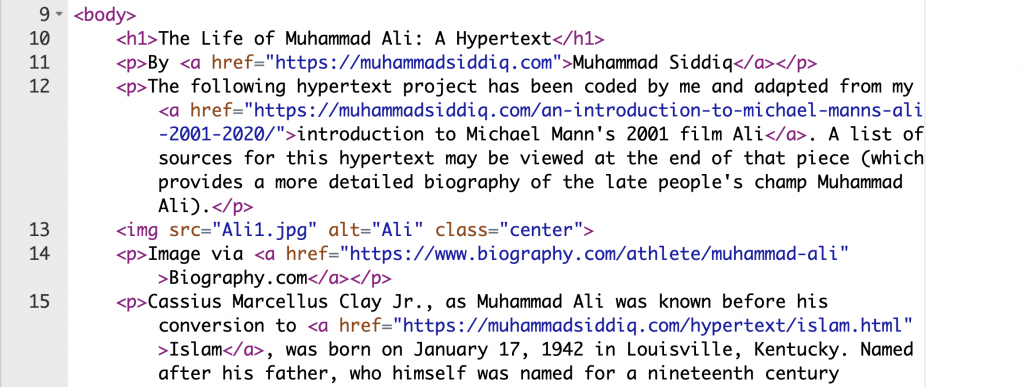
“The Life of Muhammad Ali: A Hypertext” consists of six pages focused on the following areas: an overview of Ali, Ali and Islam, Ali’s amateur career, Ali’s professional career, Ali as an activist, and Ali’s retirement and legacy. Every page on the hypertext page is interwoven, as each page contains links to the other pages in the work. One can easily bounce around between topics or end up back at the starting point. The hypertext also contains links to image sources, my original paper, and my website. Credibility was incredibly important for me here, as I chose to create an informational piece rather than a creative, fictional one. For this reason, I also chose my design to closely resemble Wikipedia.
Creating the hypertext allowed me to put into practice several of the skills I’ve been developing as a writer for the web. Firstly, it was incredibly important for me to think about where I wanted to create my links. The text associated with each link needed to be relevant to the page it was linked to, and each link had to be placed where it would catch the eye of the reader. My links also had to allow for the interwoven nature of the piece; instead of simply linking each page to a new one, I had to link back to previous pages, new ones, and the start page. It was crucial that this piece be non-linear in order for me to achieve my goal. I tediously scanned my original essay in order to divide it into various pages, and also found the text that would be used for the links. Secondly, the hypertext allowed me to think more about the use of images. For each page, it was important for me to find a relevant image that fit the aesthetic of the hypertext as a whole. From there, it was important that I size each image correctly. This practice allowed me to think more about visual design.
Overall, “The Life of Muhammad Ali: A Hypertext” has created a deeper appreciation in me for hypertextual webpages and the proper use of hyperlinks. Creating interwoven pages that feel complete on their own (and as a whole product) was much harder than I originally anticipated. The project has also sparked a bit of my curiosity for coding. While at times frustrating, creating the pages using basic HTML was enjoyable and it was satisfying to see the final product. I’m now interested in learning some CSS, so that I can build on top of the knowledge I already have and improve visual design elements. I hope you enjoy my piece as much as I enjoyed working on it!

Wow, I love how the hypertext unravels. Definitely feels like an exploration in Wikipedia, but more focused/contained, and almost more digestible. I found myself making sure I clicked all the links to find all the different paths of information, and learned more about Muhammad Ali’s life than I did before. I wasn’t aware he began his career at 18 and that he did eventually convert to Sunni Islam. Thanks for creating this network of information, we can definitely learn a lot from him.